Package retrieval technology for existing fleets
ARRIVE is a portable, infrastructure-independent package identification system for regional fleets, delivery contractors, medical couriers, and parts-delivery operators. Reusable wireless indicators help drivers identify the correct package during loading and again at the delivery stop—without cameras, projectors, wiring, permanent installation, or replacement of existing routing software.
Vehicle-based systems make the van identify the package. ARRIVE makes the package identify itself.
The missing layer for independent fleets
Major carriers are building proprietary retrieval systems into their networks. ARRIVE is designed for operators that need the same operational outcome without replacing vehicles, routing software, or warehouse infrastructure.
The repeated manual moment
Every package entering a delivery network must be identified, loaded, and retrieved. ARRIVE was built to remove that search.
At the station, drivers sort and arrange packages trying to pre-plan their truck. But once the route starts, that arrangement rarely survives the first few stops. Packages shift, stack, and get buried.
At each delivery address, drivers must physically dig through the cargo bay — reading labels, checking addresses, comparing package sizes — hunting for the right one among dozens of identical-looking boxes.
Repeated label checks slow loading and delivery stops. Across a full route, every manual search adds another small point of friction.
Route optimization has improved. Navigation has improved. But finding the right package remains one of the most manual parts of the delivery workflow.
Once the package is scanned and assigned, the correct prototype device flashes so the package can be identified without relying on the visible label.
The ARRIVE Moment
One reusable device is temporarily assigned to one package for the route. After delivery, it is recovered and reassigned.
Trigger the assigned device while organizing and loading packages.
Trigger the assigned package automatically or manually at the relevant delivery stop.
Capture the package or stop information before the route begins.
Pair one reusable ARRIVE prototype device with one package.
The driver loads packages without relying on repeated label checks.
At the stop, the correct ARRIVE prototype device flashes so the package can be identified.
Working prototype
Ten prototype devices represent ten assigned packages and ten delivery stops. As the driver reaches the correct stop, the paired ARRIVE device signals automatically.
Why ARRIVE
ARRIVE is being developed as a practical retrieval layer for regional couriers, delivery contractors, medical and parts-delivery fleets, and other operators using existing vehicles and software.
ARRIVE addresses the manual search during loading and again at the delivery stop.
The prototype workflow operates without relying on Wi-Fi or cellular service.
ARRIVE is not trying to replace logistics software. It is designed to fit alongside existing delivery workflows.
Scan the package, pair the device, load the vehicle, and identify the correct package at the stop.
The working prototype is ready for controlled fleet validation, with a defined path toward a 50-device build.
One reusable device is temporarily assigned to one package for the route, then recovered and reassigned.
Competitive context
ARRIVE is designed to bring package-level identification to operators without requiring proprietary vehicles or permanent infrastructure.
| Approach | Permanent vehicle installation | Signal located on package | Portable between vehicles | Intended market |
|---|---|---|---|---|
| Manual label search | No | No | Yes | All fleets |
| RFID reader network | Often | Usually no visible signal | Limited | Warehouses / fleet systems |
| Camera/projector system | Yes | Projected onto package | No | Integrated fleets |
| ARRIVE prototype | No | Yes | Yes | Independent and regional fleets |
Comparison reflects system architecture. Commercial performance and fleet-scale results remain subject to pilot validation.
How ARRIVE Works
The prototype demonstrates a simple sequence across the app, reusable device, and driver.
ARRIVE In Action
Designed to reduce search time during loading and at delivery stops.
Driver parks, opens cargo bay, and starts scanning labels one by one to find the right package.
Packages have shifted during the route. The pre-planned arrangement is gone. Everything has to be moved to reach the one at the back.
Every repeated label check adds friction to the route during loading and delivery.
Driver frustration builds through the shift. Fatigue, errors, and missed deliveries increase as the day goes on.
The package still depends on manual visual identification inside the vehicle.
At the stop, the assigned prototype device flashes so the package can be identified.
Even when packages shift during the route, the visible signal helps the driver locate the assigned package without repeatedly reading labels.
The driver can use the signal to locate the assigned package without relying on the visible label.
A fleet pilot will measure potential reductions in search time, physical handling, identification errors, and driver workload.
A commercial pilot can measure where and how much time is saved across a real operation.
The ARRIVE Device
The current system demonstrates the core workflow: scan, pair, load, and identify.
The assigned prototype device flashes so the correct package can be visually identified.
The demonstrated system operates without relying on Wi-Fi or cellular service.
One prototype device is temporarily assigned to one package for the route, then recovered and reassigned.
The working prototype is ready for controlled fleet validation.
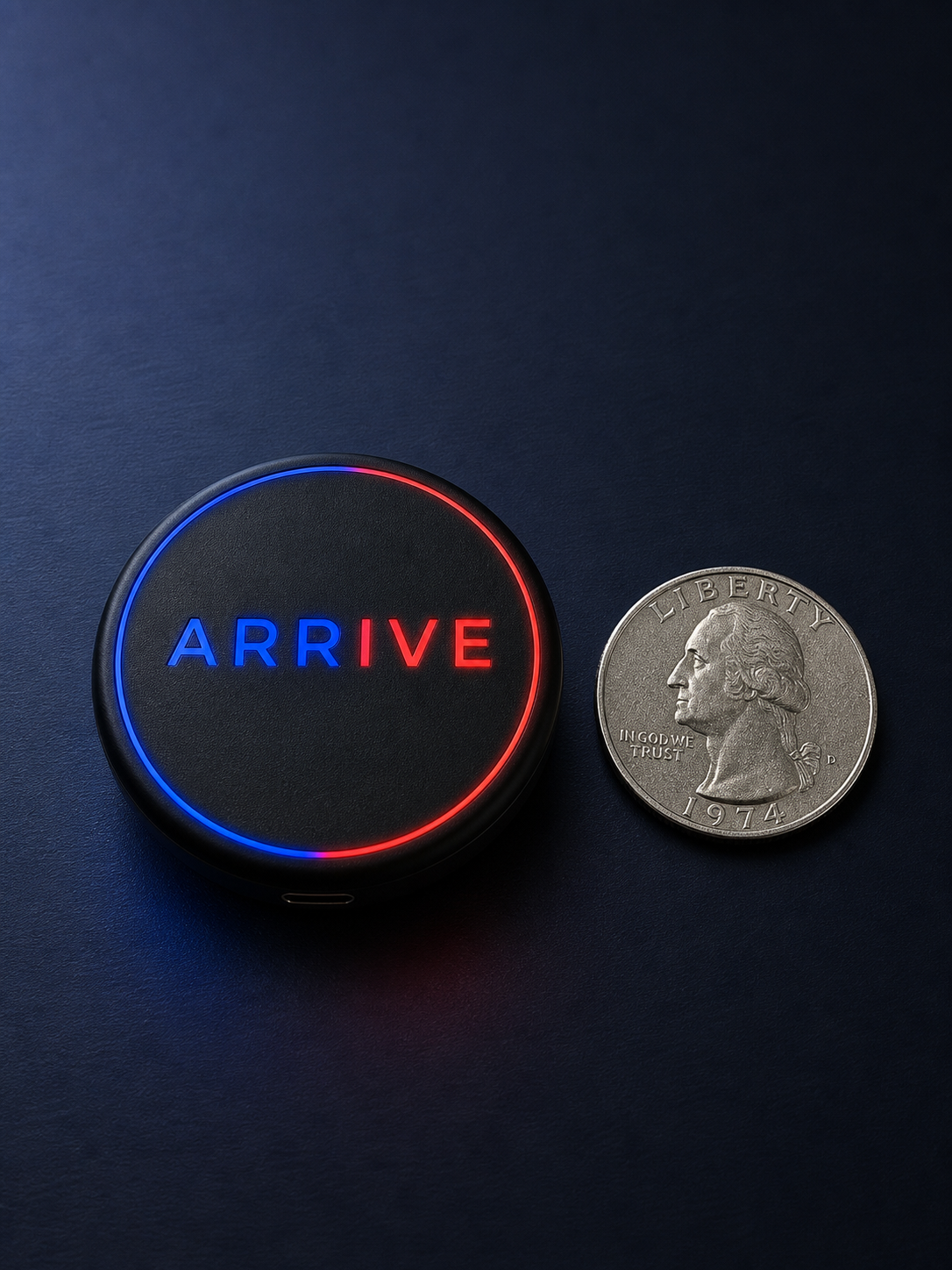
Real prototype • shown to scale
Built from the driver’s side
“I spent years delivering packages and repeating the same search at almost every stop. The industry treated it as unavoidable. I saw an operational gap: routing tells the driver where to go, but not where the package is inside the vehicle. ARRIVE was built to close that gap.”
Diego Munoz — Founder, ARRIVE
ARRIVE complements existing routing and delivery software—it does not replace it. One simple physical layer closes the gap between knowing the next stop and finding the right package.
Venture readiness
The next proof point: a controlled fleet pilot measuring retrieval time, loading time, pairing time, device recovery, signal reliability, battery performance, and minutes saved per route.
Run a measurable fleet pilot or request the investor brief covering the prototype, deployment path, and market opportunity.